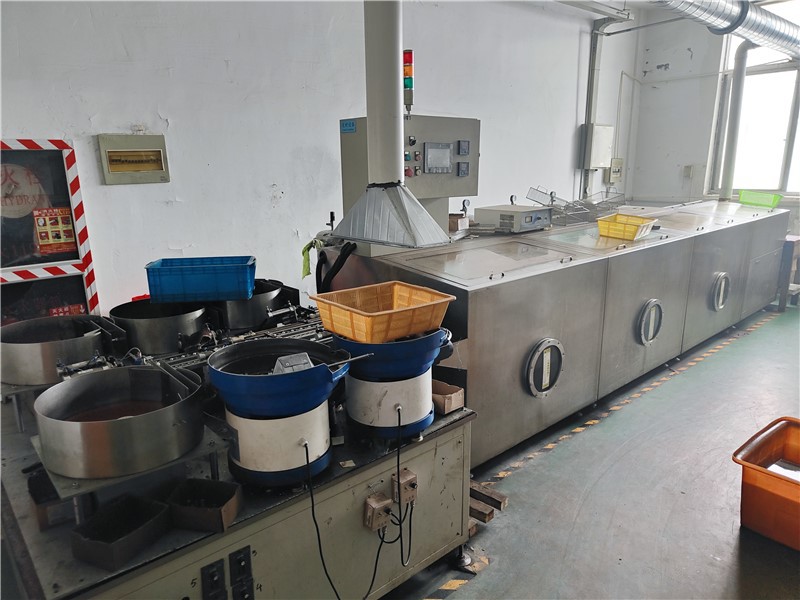

Cixi Jieduo Machinery Factory is a professional manufacturer of non-standard customized stainless steel bearings, integrating R&D and design. The company mainly produces various non-standard deep groove stainless steel bearings, stainless steel flange bearings, stainless steel double row cylindrical bearings, stainless steel medical equipment bearings, stainless steel food processing equipment bearings.
Why Choose Us
Our Products
The company mainly produces various non-standard deep groove stainless steel bearings, stainless steel flange bearings, stainless steel double row cylindrical bearings, stainless steel medical equipment bearings, stainless steel food processing equipment bearings.
Our Certificates
The company has passed the ISO9001:2015 international quality system certification. The company has a series of various processing equipment and testing equipment for the production of products that meet the international quality system certification.
Product Application
The company's products are widely used in equipment that requires corrosion resistance, high temperature resistance, and low temperature resistance.
Raw Materials
The raw materials required for the company's products come from professional metal material production plants that meet international standards.


What Is Stainless Steel Outer Spherical Bearing
Spherical plain bearings have an inner ring with a sphered convex outside surface and an outer ring with a corresponding sphered but concave inside surface. Their design makes them particularly suitable for bearing arrangements where alignment movements between shaft and housing have to be accommodated, or where oscillating movements or recurrent tilting movements must be made at relatively slow sliding speeds.
Features of Stainless Steel Outer Spherical Bearing
High Load Carrying Capacity
One of the most significant advantages of the stainless steel outer spherical bearing is its ability to carry heavy loads. This is because of its sturdy construction, which enables it to distribute the weight evenly across the bearing's surface area.
Corrosion Resistance
Stainless steel is known for its high resistance to corrosion. This makes it an excellent choice for outdoor applications where the bearing is likely to come into contact with moisture and other elements that can cause rust.
Self-aligning Capability
Another feature of the stainless steel outer spherical bearing is its ability to self-align. This allows it to compensate for any misalignment between the moving parts, thereby reducing wear and tear on the bearing and the associated components.
Application of Stainless Steel Outer Spherical Bearing

Spherical bearings are used in applications that involve oscillating, rotating, and aligning movements, such as:
Vehicle Suspensions: To accommodate changing load and road conditions while allowing for the misalignment between parts.
Heavy Equipment: For articulating joints in construction, mining, and agricultural machinery.
Hydraulic Cylinders: Acting as pivot points.
Linkages: In industrial machines, aircraft control linkages, and marine applications for smooth articulation and movement.
When selecting a spherical plain bearing for an application, considerations such as load ratings, the range of motion, environmental conditions, and required lifespan are all important to ensure the correct bearing is chosen for the specific requirements.
Components of Stainless Steel Outer Spherical Bearing
Spherical OD Deep Groove Radial Ball Bearings feature Metric spherical outer diameters that are effective in self-aligning applications. These spherical OD ball bearings are designed to fit in standard self-aligning pressed steel or cast iron applications where set screw or eccentric shaft lock is not required, or in areas where space is limited. Each spherical OD ball bearing will generally fit in the corresponding series cast iron or stamped steel housing;
These Spherical OD Metric Single Row Deep Groove Radial ball bearings are produced to Classification and are available with industrial grade 2RS double seals. The industrial grade sealed Spherical OD Deep Groove Radial Ball Bearings feature dual-lip non-contact seals on both sides. Featuring the same construction as Metric Single Row Deep Groove Radial ball bearings, the inner ring, outer ring and balls are produced using vacuum degassed 52100 bearing steel. After production, they are heat treat hardened to produce a durable wear surface on the balls and ball tracks. All ball retainers and shields are manufactured from cold rolled steel.
As a high temperature ball and roller bearing grease, it’s formulated using a synthetic poly urea ashless organic thickener with additional rust and oxidation inhibitors. As such, this grease provides protection in severe applications, harsh environments and where incidental contact with both salt and fresh water may occur.
Spherical plain bearings consist of a spherical inner ring and a concave outer ring. The inner and outer rings may be in metal-to-metal contact or may have special lubricating materials added. This design allows the inner ring to rotate and tilt freely within the outer ring, allowing movement of the connected components in multiple directions. The working principle of spherical plain bearings is that they can bear radial loads and axial loads at the same time, while providing freedom of rotation and swing. This freedom is achieved through a spherical design that allows the bearing to maintain performance at different operating angles, whether moving horizontally or vertically. Being able to adapt to complex and changing motion requirements becomes indispensable in mechanical applications that require high flexibility and reliability.
Material of Stainless Steel Outer Spherical Bearing
Three main components of which are the most often heard: Chrome steel, stainless steel, and ceramics. Thus, every includes the main four parts: The outer race, inner race, balls and cage which each has its own use of purpose and characteristics.
Usually made of a kind of steel known as carbon chromium steel, which is mostly called chrome steel. There are also other steel materials that can be produced such as stainless steel, ceramics and plastic. However, each of its characteristics serve their purposes differently.
When chrome steel is unprotected to moisture in the air, this will cause the steel itself to corrode damaging the rotation of the bearing.
Stainless Steel (SS)
Stainless steel bearings provide several significant benefits when other materials cause problems because stainless steel particularly offers greater chemical and corrosion resistance, along with better stability in high temperature environments. It has the same deep raceway grooves and close conformity between raceways and balls as standard made of carbon chromium (rolling bearing) steel.
Chrome steel (GCr15)
Chrome steel is the most common material used to produce the load carrying components in precision , and it offers a cost-effective alternative to stainless steel. While less resistant to corrosion, chrome steel is durable and still resistant to corrosive factors in certain environments.
Ceramic Ball Bearings
In contrast, are made of ceramic rather than steel. Full constructed entirely of ceramic material. The inner and outer races and balls are both made of Silicon Nitride (Si3N4) or Zirconium Oxide (ZrO2). The main characteristics are it provides higher hardness and better elasticity compared to chrome steel bearings. Furthermore, this can be run completely dry, with excellent corrosion resistance allows them to run in concentrated acids, and totally submerged in seawater without corroding. Also, it is more suitable for temperature changes, the life cycle of full is much longer than steel bearings.
How to Maintain Stainless Steel Outer Spherical Bearing
Spherical Plain Bearings requiring maintenance (steel-on-steel) have hardened sliding contact surfaces on both rings. The surfaces are typically treated with molybdenum disulphide and phosphate (this provides added wear resistance and wear-corrosion). However, Spherical Plain Bearings with this sliding contact surface combination require regular relubrication. The high strength of the sliding contact surfaces makes these bearings especially suitable for bearing arrangements where heavy loads of alternating direction, shock loads, or heavy static loads have to be accommodated.
Safety Precautions When Using the Stainless Steel Outer Spherical Bearing
Take care not to drop or strike the spherical plain bearing. Doing so may cause injury or damage.Giving an impact to it could also cause damage to its function even if the product looks intact.
When handling the product, wear protective gloves, safety shoes, etc., as necessary to ensure safety.
Prevent foreign material, such as cutting chips or coolant, from entering the product. Failure to do so may cause damage.
If foreign material such as cutting chips adheres to the product, replenish the lubricant after cleaning the product.
Do not use undue force when fi tting partsto the product. This may generate permanent deformation on the raceway, leading to loss of functionality.
Insuffi cient rigidity or accuracy of mounting members causes the bearing load to concentrate on one point and the bearing performance will drop signifi cantly. Accordingly, give suffi cient consideration to the rigidity/accuracy of the housing and base and strength of the fi xing bolts.
Do not mix diff erent lubricants. Mixing greases using the same type of thickening agent may still cause adverse interaction between the two greases if they use different additives, etc.
When using the product in locations exposed to constant vibrations or in special environments such as clean rooms, vacuum and low/high temperature, use the grease appropriate for the specifi cation/environment.The consistency of grease changes according to the temperature. Take note that the slide resistance of the spherical bearing also changes as the consistency of grease changes.
After lubrication, the slide resistance of the spherical bearing may increase due to the agitation resistance of grease. Be sure to perform a break-in to let the grease spread fully, before operating the machine.Excess grease may scatter immediately after lubrication, so wipe off scattered grease as necessary.
The properties of grease deteriorate and its lubrication performance drops over time, so grease must be checked and added properly according to the use frequency of the machine.
Our Factory
The company has a series of various processing equipment and testing equipment for the production of products that meet the international quality system certification. The raw materials required for the company's products come from professional metal material production plants that meet international standards.