
Cixi Jieduo Machinery Factory is a professional manufacturer of non-standard customized stainless steel bearings, integrating R&D and design. The company mainly produces various non-standard deep groove stainless steel bearings, stainless steel flange bearings, stainless steel double row cylindrical bearings, stainless steel medical equipment bearings, stainless steel food processing equipment bearings.
Why Choose Us
Our Products
The company mainly produces various non-standard deep groove stainless steel bearings, stainless steel flange bearings, stainless steel double row cylindrical bearings, stainless steel medical equipment bearings, stainless steel food processing equipment bearings.
Our Certificates
The company has passed the ISO9001:2015 international quality system certification. The company has a series of various processing equipment and testing equipment for the production of products that meet the international quality system certification.
Product Application
The company's products are widely used in equipment that requires corrosion resistance, high temperature resistance, and low temperature resistance.
Raw Materials
The raw materials required for the company's products come from professional metal material production plants that meet international standards.


What Is Stainless Steel Clad Plastic Bearing
Standard plastic ball bearings are made of acetal resin (POM-C) rings, nylon (PA66) cages and balls made from 316 grade stainless steel or glass. These plastic bearings are generally used as corrosion resistant bearings, non-magnetic bearings or non- conductive bearings.
Lightweight: Plastic is five times lighter than steel, thereby reducing the weight and energy to move them.
Corrosion Resistant: KMS plastic ball bearings can be utilized in environments destructive to conventional bearings. Plastic, by its nature, does not corrode. Our bearings can operate in hostile environments such as sea water, silicon wafer processing, plating solutions and swimming pools.
Customizable Design: Custom designs are readily and inexpensively made from plastics. This allows engineers complete freedom to design the bearing around the device rather than attempting to design the device around a limited range of standard bearings.
Lubrication Free: Steel bearings require lubrication to reduce friction, dissipate heat and prevent corrosion. Due to the design of plastic ball bearings, there is no metal to metal contact, which results in less friction. Many times the liquids the bearings are running in can dissipate heat and act as the lubricant.
Noise Control: Plastic has the inherent ability to dampen vibrations. Add lubrication and they become virtually silent.
Product Integration: A plastic bearing can be mounted into other components or parts such as plastic wheels, pulleys or housings. In certain design concepts, seamless integration can be achieved where the bearing will have the pulley profile as the outer ring, and the shaft or a fixing clip replaces the inner ring. This integration lowers assembly time and also results in the utilization of fewer parts, increasing affordability.
Cleanliness/Hygienic: Plastic bearings generally operate cleaner than metal bearings because they do not need lubrication, they are resistant to corrosion, and they can be washed down without the worry of re-lubing. This capability makes them a viable option for cleanroom environments, and wash down applications. A plastic bearing made from either PBT, PVDF or PEEK can be post sterilized by standard methods such as autoclave or Gamma.
Shock Absorption: Plastic absorbs shock loads better than metal due to its elastic nature. Many conventional ball bearings fail due to brinelling of the raceway, i.e. balls denting the raceways.
Low Inertia: Freer Turning Naturally
Characteristics which contribute to low inertia
Low coefficient of friction between plastic and stainless.
Can run dry without grease
Lighter in weight
Non-Magnetic: Plastic ball bearings become completely nonmagnetic when fitted with polymer, glass, or nonmagnetic 316 stainless balls. They are ideal for use in MRI X-ray equipment or sensors where there cannot be magnetic distortion.
Components of Stainless Steel Clad Plastic Bearing
Our plastic bearings consist of outer races, inner races, balls, and retainers.
We have six types of plastic outer races and three types of inner races. Inner laces are available to choose how to attach to mating parts. These can be flexibly combined according to customer requirements.
For example, when you use on a desk drawer, we recommend a combination of a flat outer race (R in the figure) and a screw-type (B in the figure) inner race. It can be easily assembled to the drawer with screws, also it allows the flat rail to run smoothly.
Plastic Bearing Outer Race Types
We have Flat type, convex type, flange type, concave type, u-groove type and v-groove type outer races. Plastics can be easily molded by injection molding, so many types can be made.
The main applications for each shape are as follows;
R: Flat outer circumference, used in a wide range of industries. Mainly used for office desks and refrigerator drawers.
O: Outer circumference convex R shape. Often used as a bearing running on rails with concave R shape, which makes it relatively difficult for the wheel to come off the rail. When running on a flat surface, the contact surface becomes a point contact, which is useful for suppressing running noise when the mating material is made of aluminum, which is prone to resonance.
F: Flanged shape. When bearings are used on both sides of a drawer, one side of the bearing is flanged. This will prevent rattling and maintain smooth movement when pulling out the drawer. In factory and distribution equipment-related applications, it is sometimes used to insert on both sides of pipes of conveyor rollers to prevent them from entering the pipes with flanges.
H: Outer circumference concave groove shape. Works well with convex rails such as curtain rails and screen doors.
U: Outer circumference U-groove shape. This product is widely used as a door roller for hanging doors, such as storage rooms and closets.
V: Outer circumference V-groove shape. Many of them are used as wire pulleys.


Plastic Bearing Inner Race Types
We have three types of inner races: Hole type, screw type, and rivet type.
The hole type is the same mounting method as for metal bearings. This is best for use through the shaft, but when preparing a separate part and attaching it to the mating part, it is easier to use the caulking shape or the screw shape .
Plastic bearings with rivet inner races can be easily installed by inserting the shaft portion of the inner race into a hole in a pressed part or sheet metal and crushing the shaft portion with a riveting machine. However, since the shaft part cannot be quenched (surface hardening treatment) in order to crush it, we recommend using hole or screw type if you want to increase the allowable load. If you want to attach the shaft by riveting, we also have a type with the shaft pre-installed in the hole shape.
Material of Stainless Steel Clad Plastic Bearing
Polytetrafluoroethylene (PTFE)
A heat-resistant polymer and a fluorinated thermoplastic that has excellent chemical resistance, low leaching, and excellent lubricity.
Teflon
A registered trademark of DuPont Dow Elastomers and is a proprietary form of PTFE used in many plastic bearings.
Nylon
A category that includes several grades of polyamides and is commonly used as a bearing surface material due to its toughness, resistance, and pressure rating.
Semi-crystalline acetal polymers
Have excellent lubricity, fatigue resistance, and chemical resistance; however, they can have outgassing issues at high temperatures and become brittle at low temperatures.
How the Stainless Steel Clad Plastic Bearing Works
When the system first starts moving, the bearing deposits bits of solid lubricant from its inner diameter into the shaft, filling in the shaft roughness with its material. There is an initial spike in friction between the shaft and plastic bearing. However, the shaft will smooth out due to the deposits and gradually, the amount of friction between the shaft and the bearing down-regulates.
How to Maintain Stainless Steel Clad Plastic Bearing
Clean as required to maintain appearance. It is important to not let dirt accumulate.
Dirt and grease accumulate from many sources. These can usually be removed by routine cleaning using soap, ammonia or detergent and fresh warm water. For bright polished stainless steel it is best to avoid any abrasive cleaners as these will scratch the surface.
A clean, dust and grit free cloth should be used to avoid scratching. In all cases the mildest cleaning procedure that will do the job efficiently should be used. We recommend a wash down with warm fresh water and washing up liquid followed by a wash of clean warm water only,finish by wiping dry with a clean absorbent cloth. For stubborn areas of dirt a soft brush could be used.
Stainless steel items should be cleaned by wiping once a week where practicable. Brown staining of stainless steel items is an indication of either an inadequate cleaning regime or an aggressive environmental atmosphere. Carbon steel brushes or carbon steel wire wool should never be used on stainless steel. Chemical cleaners must be compatible with stainless steel.
It is important to always clean in the direction of the original polish lines.
DO NOT use any harsh abrasives on any polished stainless steel surface.
DO NOT use any strong mineral acids near areas of stainless steel, these should never come into contact. If this does occur, the acid solution should be washed of immediately with plenty of water.
DO NOT use pads of ordinary steel wool incorporating soap. There is a danger that particles of plain carbon steel from the pads may be left behind after rinsing and leave unsightly rust stains.
Our Factory
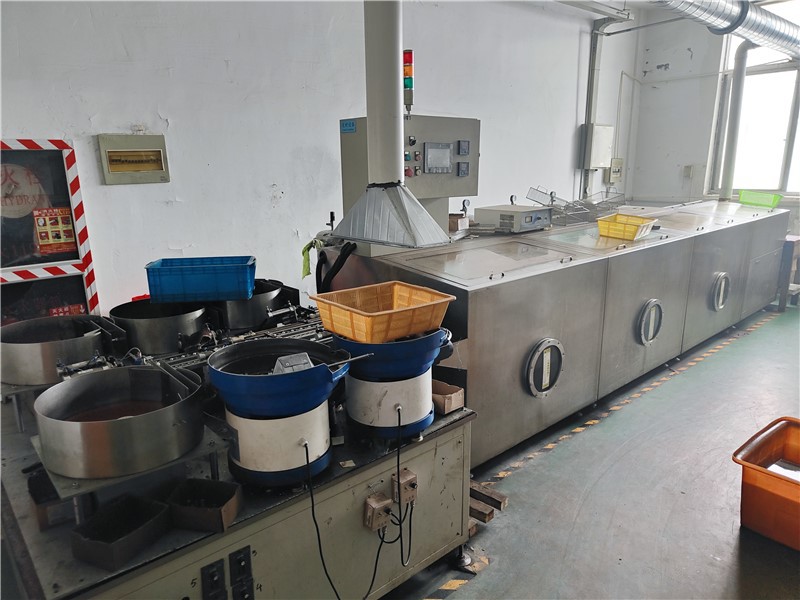
The company has a series of various processing equipment and testing equipment for the production of products that meet the international quality system certification. The raw materials required for the company's products come from professional metal material production plants that meet international standards.